Biogas Flare Systems Supplier Evaluation: Capability, Materials, and Delivery Assurance
Evaluating a supplier for a biogas flare project is not a catalogue comparison. A flare is sized on one project's design basis, fabricated from a specified metallurgy, and accepted against tests that must be agreed before the purchase order is issued. When the flare is destined for landfill gas, anaerobic digestion gas, or wastewater treatment gas, a buyer moving from evaluation into execution has three questions that can actually be verified: what the supplier manufactures itself, what material will sit in the gas path, and what protects the delivery date.
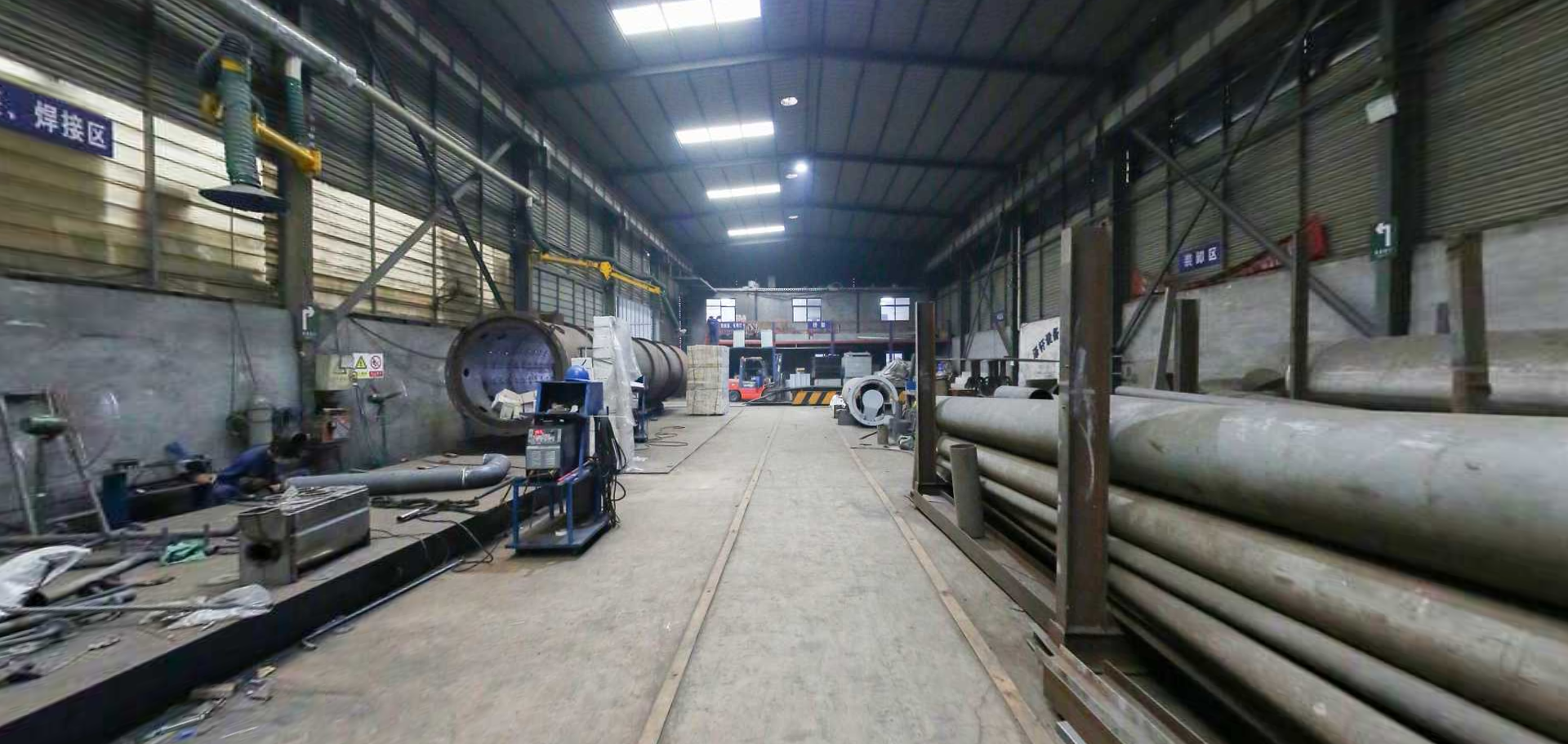
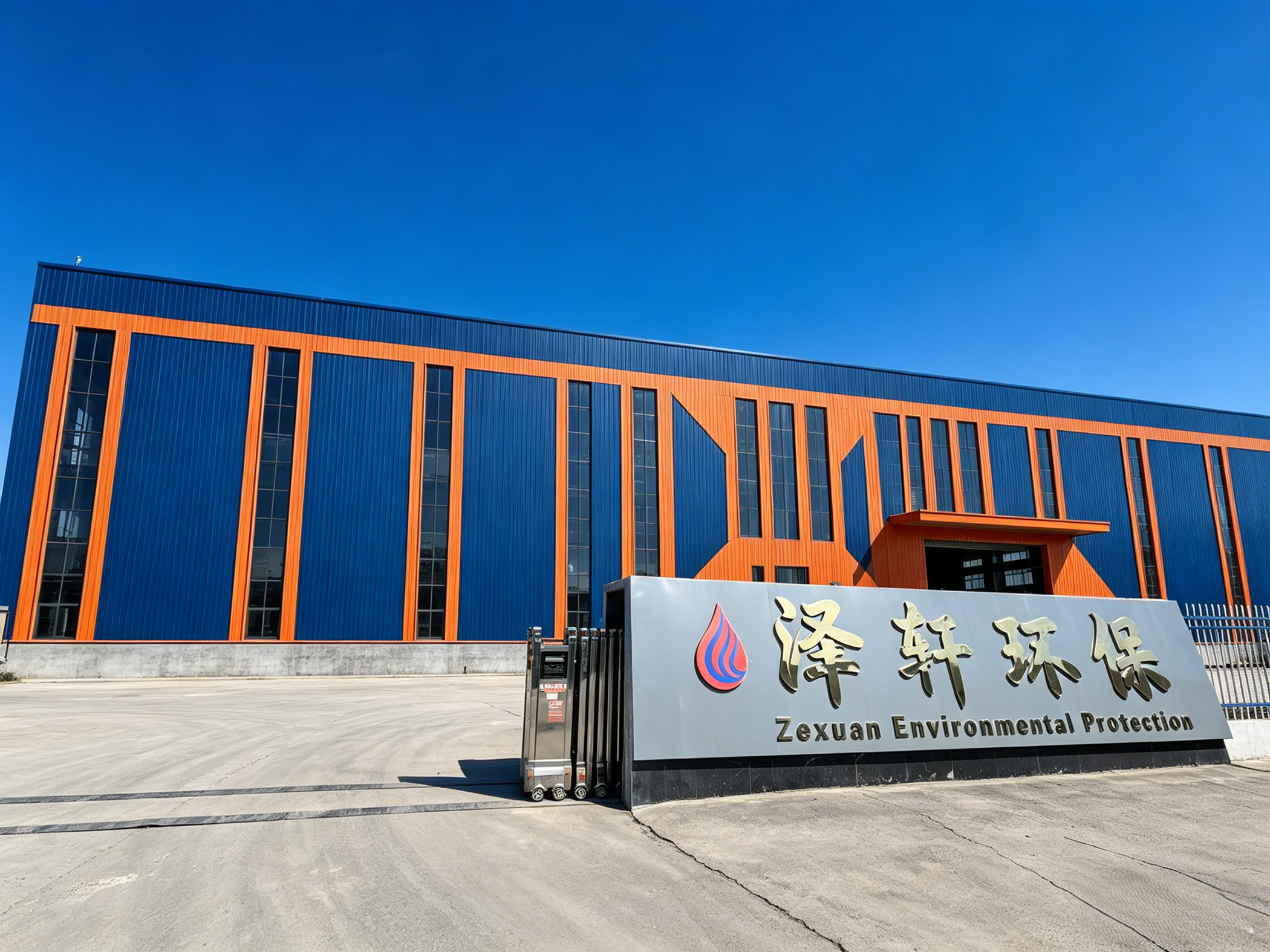
Shandong Zexuan Environmental Protection Technology Co., Ltd. (Zexuan) is a manufacturer and engineering service provider of industrial flare systems and thermal treatment equipment, established in 2015 and operating a 24,100 m² manufacturing base. Its documentation is used below as a worked example of the evidence a supplier should be able to produce. The verification logic applies to any name on a shortlist; the specific series names and figures show the level of detail worth demanding.
Why biogas flare sourcing fails at the evaluation stage
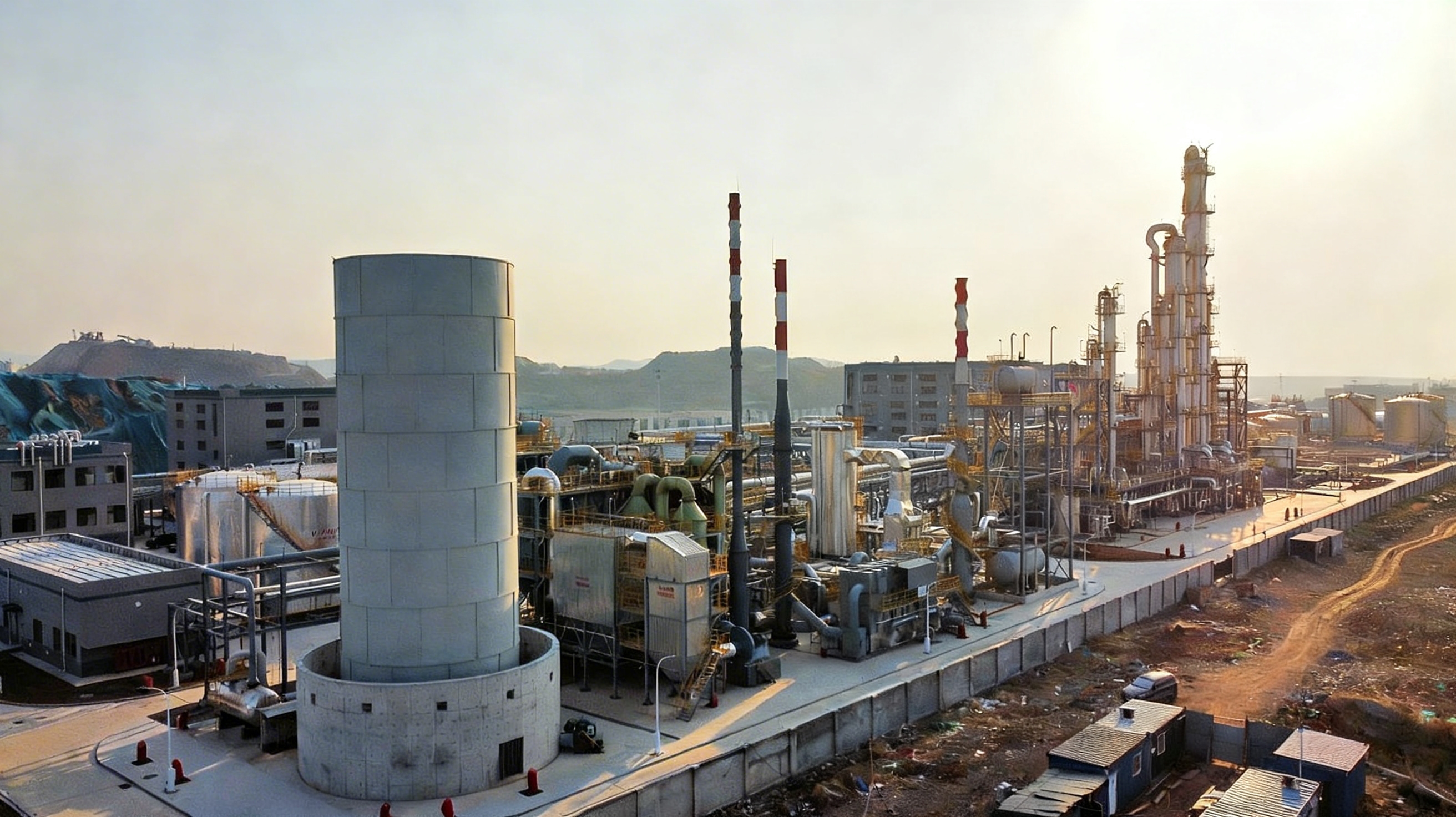
The evaluation stage for a flare is unusual because the product does not exist yet. Buyers cannot inspect a combustion device that will be built in 60 to 120 days, so they end up comparing brochures, and brochures hide three predictable gaps.
- Scope gap. The quotation covers a flare, but the site also needs gas treatment, a thermal oxidizer, or a skid package. Sub-supplied items then carry their own delivery risk, and that risk was never priced or scheduled.
- Material gap. The data sheet says "carbon steel / stainless steel" without stating which component receives which grade. Substitution stays invisible until welding records and inspection reports arrive at the factory acceptance stage.
- Delivery gap. Lead time is quoted as an intention rather than a milestone chain, and acceptance criteria are pushed to the end of the project, when there is no schedule left to correct anything.
All three gaps are closable with documents, and all three can be closed before the order is placed. The rest of this guide shows what to ask for, in what order, and what a credible answer looks like.
Industry background: documentation is now part of the product
Two independent pressures have moved paperwork from an administrative detail to a scored capability. The first is volume. World Bank satellite-based global flaring data puts flaring volumes at 151 billion cubic metres in 2024, the highest level since 2007, which keeps flare equipment in continuous procurement across upstream, refining and waste-to-energy applications. Commercially, Dataintelo's flare systems research report values the global flare systems market at approximately USD 4.8 billion in 2025; that figure is commercial research rather than an audited statistic, so treat it as an order-of-magnitude indicator only.
The second pressure is regulatory, and it is the one that changes how suppliers are evaluated. The U.S. EPA defines a flare as a thermal oxidation system using an open flame without enclosure. That definition matters for biogas buyers because enclosed ground flare designs exist precisely to contain the flame and reduce radiation and noise, so a scope check has to cover both enclosed and open configurations rather than assuming one.
EPA technical material also states that properly operated flares achieve at least 98 percent destruction efficiency in the flare plume. The important development is what happened to that number in regulation: under NSPS OOOOb (40 CFR 60.5360b, effective 7 May 2024), operators can no longer simply assume a default 98 percent destruction efficiency — actual performance has to be demonstrated. In the cited U.S. refinery context, EPA references a combustion-zone net heating value limit of at least 270 Btu per standard cubic foot on a 15-minute block basis, together with continuous monitoring of assist air and assist steam volumetric flow. These are U.S.-specific rule contexts and must not be generalised to other jurisdictions or to every flare type.
The three-workstream evaluation model
Split the evaluation into manufacturing scope, material verification, and delivery assurance, and score each separately. Suppliers that look equivalent on a combined score often differ sharply once the three are separated, and separating them prevents a strong factory photograph from compensating for a weak metallurgy statement.
Workstream 1: Verify manufacturing scope, not product names
A product list is evidence only when every line item maps to a fabrication route and a model designation you can reference in a purchase order. Zexuan publishes a project-customized series structure that can be used as the reference format for this check:
- ZXE-SSEF — self-supported elevated flare
- ZXE-GWF — guyed-wire elevated flare
- ZXE-DSF — derrick-supported elevated flare
- ZXE-EGF — enclosed ground flare
- ZXE-SMF — skid-mounted flare system
- ZXE-MTF — mobile trailer flare system
- ZXE-FT — flare tip series
- ZXE-TO / ZXE-RTO / ZXE-RCO — thermal oxidizer systems
Beyond flares, the company's scope covers industrial incineration systems and flue gas treatment and waste heat recovery equipment, and its stated target industries include municipal landfill and biogas alongside oil and gas, refining and petrochemical, LNG terminals, and chemical processing. For a biogas project this breadth matters because landfill and digester sites frequently need more than combustion: condensate and knock-out provisions, VOC control where the site also handles odorous streams, or a skid package for a remote gas field. Two suppliers advertising "biogas flare systems" can therefore have very different boundaries of supply — and the boundary, not the product name, is what determines who owns the interfaces.
Within that structure, the ZXE-BGF biogas flare is the designation applied to landfill gas, anaerobic digestion, and wastewater treatment gas duty, while the ZXE-EGF Series enclosed ground flare is documented as a low-radiation design with refractory lining, operating at 800 °C–1200 °C with combustion efficiency up to 99.9 %, and specified for LNG terminals, chemical plants and petrochemical parks. For a landfill or digester gas project, the practical question is whether the same enclosed, refractory-lined construction route and its material options are available for the biogas duty you are specifying, and which series number will appear on the drawing.
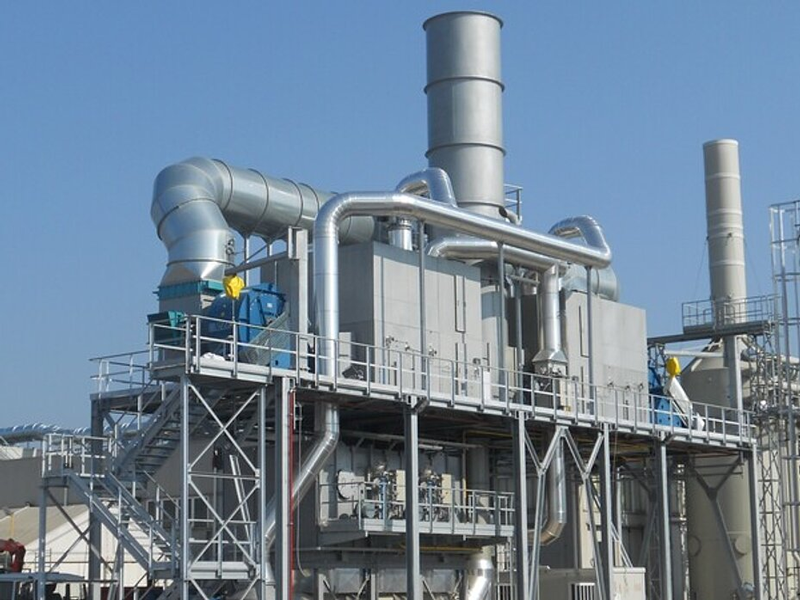
Customization is the other half of scope verification. Zexuan documents manufacturer, OEM, ODM and engineering solution production services, with customization covering flare type, capacity, material, structure, control system, layout, voltage and documentation. For an execution-stage buyer the last two items are the ones that cause delays: layout drawings that must match an existing plot plan, and a documentation package that must satisfy a local authority or an EPC's handover file. Ask for a sample document register before award.
Workstream 2: Verify material grade against the duty, not against a data sheet headline
Material verification is the step most often compressed into a single line. It should be expanded into a component list instead. For each component in the gas path and each high-temperature component, the buyer needs three facts: the base grade, the protective lining or refractory where applicable, and the inspection record that proves the grade was received and welded as specified.
The supplied specification set for the ZXE range uses carbon steel, SS304, SS316L, SS310S and Inconel 625 across different equipment, plus refractory materials in the enclosed ground flare and the incinerator, and ceramic heat storage media in the regenerative oxidizer configurations. The distribution of grades is itself the diagnostic signal. Inconel 625, for example, appears in the ZX-FT flare tip range, which is documented for smokeless, sonic, air-assisted and Coanda operation at temperatures up to 1100 °C with customizable diameter and gas capacity for hydrocarbon gases in refinery, petrochemical, LNG and oil and gas processing. If a quotation lists Inconel 625 as a general material option, ask which component it applies to; a statement that cannot be located to a component is not a specification.
The same logic applies at the other end of the list. Carbon steel appears in the enclosed ground flare, the thermal oxidizer range and the incinerator, which means "carbon steel construction" can describe a housing, a structural support, or ductwork — three very different scopes of corrosion and temperature exposure. A supplier who can name the component, the grade and the inspection gate in one answer has a traceable bill of materials. A supplier who cannot is asking you to accept the drawing as the record.
Quality control is where material verification becomes auditable. Zexuan documents a full-process inspection sequence with 100 % inspection: incoming material inspection, welding inspection, dimensional inspection, pressure and leak testing where applicable, functional testing, factory acceptance testing, and final inspection before shipment. Incoming material inspection is the gate that protects everything downstream, so it is the one to examine first. Ask what the incoming check records, who signs it, and whether the record is released with the equipment or retained internally.
Workstream 3: Convert delivery promises into contracted milestones
Delivery assurance is a commercial exercise, not a factory visit. The relevant facts are capacity, lead time, minimum order quantity, delivery terms, payment structure and acceptance criteria — and each has a specific contractual action that turns a statement into an obligation.
Zexuan documents a monthly capacity of 5 sets per month for customized industrial systems, a lead time of 60–120 days depending on project requirements, and a minimum order quantity of 1 set. Those three figures interact. If a program needs several systems across two sites, five sets per month is shared across the supplier's entire order book, so the meaningful question is not "what is your capacity" but "which production slot is reserved for this order, and what is the design-freeze date that protects it".
Acceptance is the second half. Zexuan documents Factory Acceptance Test and Site Acceptance Test as the acceptance basis, supported by the inspection sequence described above. FAT is where most of the technical risk should transfer: it is the last point at which a wrong material grade, a missing control function or a dimensional clash can be corrected at the supplier's cost rather than on your site. SAT then confirms that the unit behaves as tested once installed, connected and commissioned.
Step-by-step: a verification sequence you can run before award
The sequence below front-loads the items that are expensive to change later. Each step produces a document you can attach to the purchase order.
- Lock the duty envelope. Write the gas source, expected flow range, composition variability and turndown expectation into the RFQ. Without a fixed envelope, every later comparison is between different design bases.
- Request the series designation and boundary-of-supply matrix. Ask which of the supplier's own series will be quoted and where its scope stops — flare only, flare plus knock-out, flare plus control system, or a complete skid.
- Request a component-level material list. One row per component: grade, thickness, lining or refractory, and the inspection gate that verifies it.
- Request the inspection and test plan. Map it against the supplier's published gates — incoming material, welding, dimensional, pressure and leak testing where applicable, functional testing, FAT, final pre-shipment inspection.
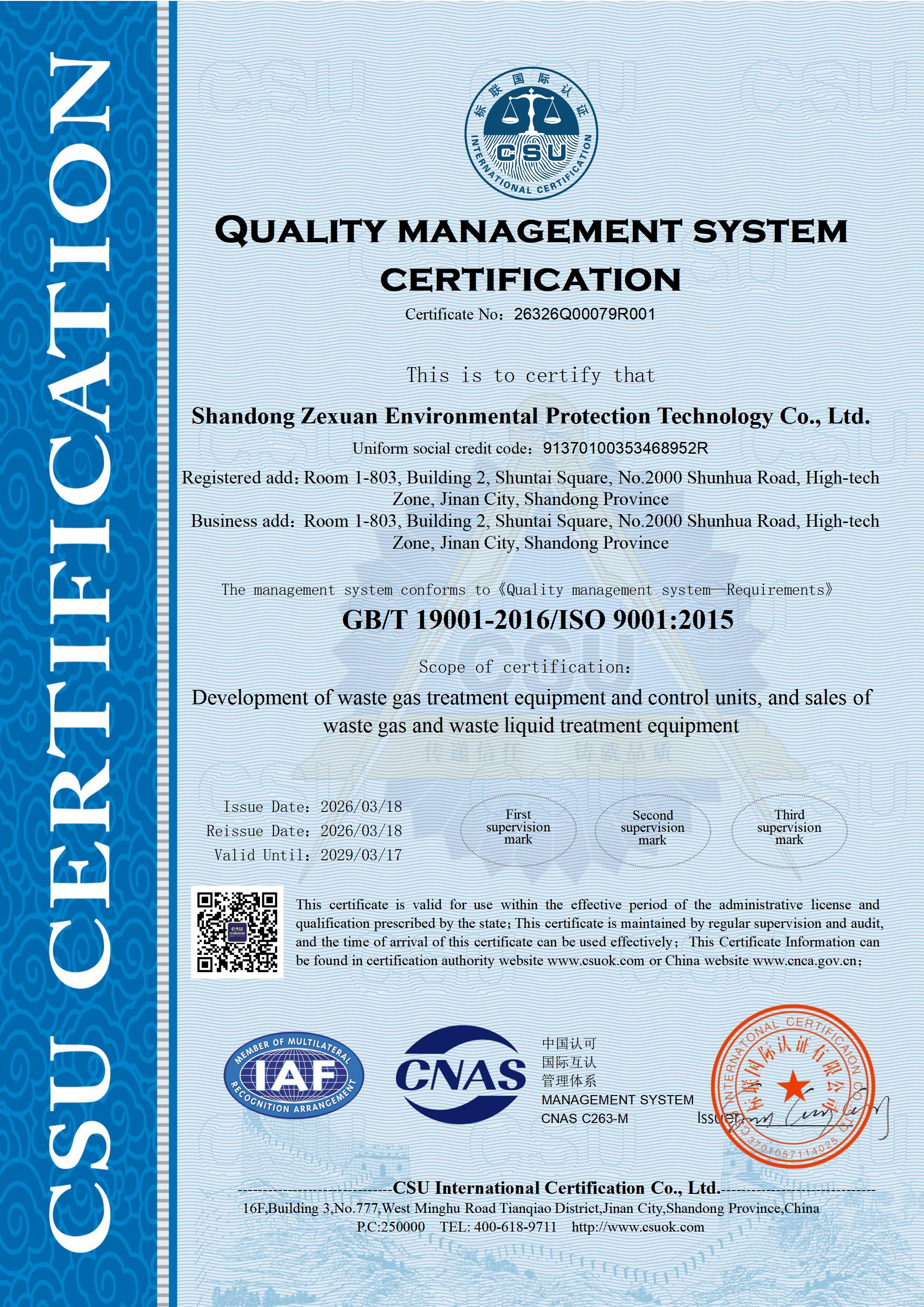
- Read the certificates, not the logos. Zexuan holds an ISO 9001:2015 quality management certificate (26326Q00079R001), an ISO 14001:2015 environmental management certificate (26326E00054R001) and an ISO 45001:2018 occupational health and safety certificate (26326S00054R001), all issued by CSU International Certification Co., Ltd. on 18 March 2026 and valid to 17 March 2029, with CNAS accreditation for the domestic China market and IAF multilateral recognition for international markets. Check the scope sentence against the equipment you are buying; a certificate for waste gas treatment equipment development and sales is not automatically a certificate for the exact package on your order.
- Fix the commercial terms in the RFQ response. Minimum order quantity, delivery term, payment structure and acceptance criteria should be stated in the quotation, not negotiated after technical approval.
- Reserve the production slot in writing. Convert the 60–120 day lead time into named milestones: design freeze, material release, fabrication complete, FAT date, shipment.
- Define SAT and after-sales support. Zexuan documents remote support, commissioning assistance, spare parts and training; agree the scope of each before award, because commissioning support is the most common source of post-delivery dispute on exported flare packages.
Material-to-duty reference table
Use the table below as a comparison template. The middle column states where each material appears in documented Zexuan series specifications; the right-hand column is the verification request that converts the statement into a traceable commitment.
| Material | Where it is documented in the ZXE specification set | Verification request to place on the supplier |
|---|---|---|
| Carbon steel | ZXE-EGF enclosed ground flare; ZXE-TO/RTO/RCO thermal oxidizers; ZXE-INC incineration system | Name every component supplied in carbon steel and the corrosion or temperature protection applied to each |
| SS304 | ZXE-EGF enclosed ground flare; ZXE-TO/RTO/RCO thermal oxidizers | Confirm the specific internals or liners and the thickness schedule used |
| SS316L | ZXE-EGF enclosed ground flare; ZXE-FT flare tip range; ZXE-TO/RTO/RCO thermal oxidizers | Confirm grade certificate availability and the welding procedure applied to the grade |
| SS310S | ZXE-EGF enclosed ground flare; ZXE-FT flare tip range; ZXE-INC incineration system | Confirm which high-temperature components use it and the design temperature assumed for each |
| Inconel 625 | ZXE-FT flare tip range, documented up to 1100 °C | Confirm it applies to the tip and internals, not to the general structure |
| Refractory materials | ZXE-EGF refractory lining; ZXE-INC refractory materials | Request the lining schedule, anchor details and the inspection gate for lining thickness |
| Ceramic heat storage media | ZXE-TO/RTO/RCO thermal oxidizer configurations | Request media specification and replacement interval assumptions |
Delivery assurance checklist
The second table converts Zexuan's documented commercial position into contract actions. The same eight rows work as an RFQ annex for any supplier.
| Item | Documented position | Contract action |
|---|---|---|
| Minimum order quantity | 1 set; systems are customized per project | State whether MOQ applies per system or per order |
| Lead time | 60–120 days depending on project requirements | Convert to a milestone schedule with a named FAT date |
| Production capacity | 5 sets per month for customized industrial systems | Obtain written slot reservation for the project window |
| Delivery terms | EXW / FOB / CIF | Fix the Incoterm and the named place in the purchase order |
| Payment terms | T/T, L/C available; typically 30 % advance and 70 % before shipment, negotiable | Tie the balance to FAT completion rather than to shipment alone |
| Acceptance criteria | Factory Acceptance Test plus Site Acceptance Test | Attach the FAT protocol and SAT criteria as PO annexes |
| Inspection sequence | Incoming material, welding, dimensional, pressure/leak where applicable, functional, FAT, final pre-shipment; 100 % inspection | Approve the inspection and test plan before fabrication release |
| Management system certificates | ISO 9001:2015, ISO 14001:2015, ISO 45001:2018; issued 2026-03-18, valid to 2029-03-17 | Confirm the certified scope covers the equipment being purchased |
What reference projects prove — and what they do not
Reference lists are usually read as proof of performance. They are better read as proof of scope. The documented Zexuan references below demonstrate fabrication and control-integration capability on methane-bearing and pyrolysis gases; none of them is a landfill gas or digester gas installation, and none establishes a destruction efficiency for your specific gas composition.
- Oil and gas, China — enclosed ground flare. One set installed at an oilfield transfer station for natural gas vent gas, completed within one year, with enclosed ground flare design, explosion-proof control cabinet and automatic ignition; documented outcomes include safe gas disposal, reduced noise and visual impact, and stable operation. What it demonstrates: enclosed configuration plus hazardous-area control integration.
- Natural gas processing, China — guyed-wire elevated flare. Two sets for emergency venting during gathering and transportation, with a 60 m elevated structure, DN350 flare tip, and automatic ignition with PLC control; documented as operating stably under harsh climate conditions for more than a year. What it demonstrates: tall structural fabrication and PLC-based ignition control.
- Coalbed methane, China — ground flare. One set with a documented processing capacity of 90×10⁴ Nm³/d, a three-stage venting design and PLC automatic control, in operation for more than two years with stable methane combustion. What it demonstrates: high-flow methane handling and staged venting logic.
- Pyrolysis gas, Iraq and Turkey — skid-mounted ground flare. One set each; the Iraq unit has operated for more than three years treating combustible pyrolysis gas with a skid-mounted modular design, and the Turkey unit for more than two years with a compact modular structure. What they demonstrate: modular packaging for sites with limited installation capability.
Two conclusions follow. First, ask a supplier to classify each reference by gas type, configuration and year of operation, and discount any reference that cannot be classified. Second, treat process-gas references as evidence of fabrication and control scope rather than as a substitute for a project-specific design review — the design basis, not the reference list, decides whether the flare performs on landfill gas with its particular flow variability.
Frequently asked questions
What compliance documentation should a biogas flare supplier provide?
Separate design references from certificates. API 521 is titled Pressure-relieving and Depressuring Systems and is identified as identical to ISO 23251; citing it describes a design basis, not a certification, and a supplier's reference to API 521 does not by itself prove compliance for your project. Certificates are a separate category: Zexuan holds ISO 9001:2015 (26326Q00079R001), ISO 14001:2015 (26326E00054R001) and ISO 45001:2018 (26326S00054R001), issued 18 March 2026 by CSU International Certification Co., Ltd. and valid to 17 March 2029. Read the scope sentence on each certificate and confirm it covers the equipment you are buying. Where U.S. rules apply, also ask how actual flare performance will be demonstrated, because NSPS OOOOb removed the option to assume a default 98 percent destruction efficiency.
Which flare and thermal treatment configurations can one supplier realistically cover?
Look for a series structure that maps each configuration to a model designation. Zexuan documents ZXE-SSEF self-supported elevated flares, ZXE-GWF guyed-wire elevated flares, ZXE-DSF derrick-supported elevated flares, ZXE-EGF enclosed ground flares, ZXE-SMF skid-mounted systems, ZXE-MTF mobile trailer systems, ZXE-FT flare tips and ZXE-TO/RTO/RCO thermal oxidizer systems, plus industrial incineration and flue gas treatment equipment. The evaluative question is not how long the list is, but where the supplier's scope ends and a third party's begins on your specific package.
How do I confirm that SS316L or Inconel 625 was actually used?
Ask for a component-level material list rather than a general material statement. In the documented ZXE specifications, Inconel 625 appears in the ZXE-FT flare tip range, which is rated to 1100 °C for smokeless, sonic, air-assisted and Coanda operation, while SS316L appears across the enclosed ground flare, tip and thermal oxidizer ranges. Once the grade is tied to a component, verify it through the inspection sequence: incoming material inspection is the first gate, followed by welding inspection, dimensional inspection and pressure or leak testing where applicable, under a documented 100 % inspection regime. Request that the relevant records be released with the equipment.
What purchasing terms apply to a customized biogas flare system?
Zexuan documents a minimum order quantity of 1 set, with systems customized to project requirements. Delivery terms are EXW, FOB or CIF, and payment is available by T/T or L/C, typically 30 percent advance with 70 percent before shipment, negotiable according to project requirements. Acceptance is based on Factory Acceptance Test plus Site Acceptance Test. For budgeting, note that the payment milestone is the negotiable element most worth aligning to technical progress rather than to calendar dates.
Can the flare be validated before shipment?
Yes, that is what the Factory Acceptance Test is for. In Zexuan's documented sequence, functional testing and FAT precede final pre-shipment inspection, supported upstream by incoming material, welding, dimensional and — where applicable — pressure and leak testing, all under 100 % inspection. Agree the FAT protocol as a purchase order annex so that the test proves the functions you specified, and plan the Site Acceptance Test to confirm behaviour after installation and commissioning, with remote support, commissioning assistance, spare parts and training available as after-sales scope.
What lead time should we plan for?
Zexuan states a lead time of 60–120 days depending on project requirements, against a documented capacity of 5 sets per month for customized industrial systems. Because that capacity is shared across the order book, the useful planning step is to reserve a production slot and express the lead time as milestones — design freeze, material release, fabrication complete, FAT, shipment — so that a delay is visible at the stage where it occurs rather than at the port.
Is Zexuan an OEM flare systems manufacturer?
Yes. Zexuan documents its production mode as manufacturer, OEM, ODM and engineering solution provider, with OEM and ODM services available for clients building industrial systems under their own brand or to customized specifications. Customization covers flare type, capacity, material, structure, control system, layout, voltage and documentation, with a minimum order quantity of 1 set and a typical lead time of 60–120 days depending on project requirements. For an OEM evaluation, request the documentation package and a sample document register early, since layout drawings and handover documentation are usually the items that determine whether an OEM schedule holds. You can request that package, or the company brochure, through the contact details below.
Conclusion
Biogas flare supplier evaluation becomes tractable once it is split into three verifiable workstreams. Manufacturing scope tells you whether the supplier builds the whole package or assembles part of it, and which series number will appear on the drawing. Material verification tells you which grade sits in which component, and whether the incoming material and welding records will reach you with the equipment. Delivery assurance tells you whether capacity, lead time, acceptance testing and payment milestones are contractual commitments or good intentions.
Zexuan's documented position — a 24,100 m² manufacturing base, a ZXE series covering elevated, enclosed ground, skid-mounted, mobile, flare tip and thermal oxidizer configurations, a stated capacity of 5 sets per month, a 60–120 day lead time, 1 set minimum order quantity, and FAT plus SAT acceptance against a 100 % inspection regime — is enough to support a prequalification decision. What it does not replace is your own project design basis, and no supplier's reference list should be read as a performance guarantee for a gas composition it was never tested on.
For buyers who want to move from evaluation into execution, the next step is a documentation request: the series designation and boundary-of-supply matrix, the component-level material list, the inspection and test plan, and the current certificate set. The Zexuan company brochure summarises the product range and manufacturing base, and additional technical material is available on the Zexuan official website. Contact Alice at alice@zexuaneco.com or +86 18678831572 for a project-specific documentation package, quotation, or a factory audit slot at the Heze manufacturing base.
Have Questions or Need More Details?
Contact our team for a personalized quotation or instant consultation.
Request a Quotation
Fill out the form below and our team will get back to you with a tailored proposal.
WhatsApp Direct Chat
Prefer to chat in real-time? Message us on WhatsApp for instant assistance & quick answers.
- Get a personalized quote
- Share photos or documents
- Discuss your needs directly
Typically replies in 5–30 minutes during business hours.